

Key Takeaways
Jev is built for fast decisions, not text generation, making it useful for classification, routing, scoring, and repetitive tasks.
Its strengths are speed, low cost, and calibrated confidence, with structured outputs like Choice, Noul, and Score.
Jev works as a decision layer inside larger systems, but confidence does not guarantee correctness, so human review remains important for uncertain or high-impact decisions.
Here is a puzzle. What if an AI could make a decision faster than you can blink, but could never say a single word? Would it be useful?
ChatGPT or Claude, these are large language models, called LLMs for short. Each one is a storyteller. It answers one small piece of a word at a time, guessing what comes after: “The... cat... sat... on... the...” They are wonderful at conversation. But when software only needs a quick answer, such as “yes” or “billing team”, a storyteller is slow, and it charges money for every piece it writes.
In September 2026, a company called TypeSafe AI (typesafe.ai) released something different, a model named Jev. It was founded by Diogo Almeida, one of the many researchers who helped build the ideas behind ChatGPT at OpenAI. After nearly two years working in stealth, the company revealed Jev, and it became a hit.
Jev does not write stories. It makes decisions. TypeSafe calls this new family of models System One, after the quick, gut-feeling side of thinking that shouts “duck!” before you have time to reason.
Picture a self-driving car. Turn left or right? That is a decision, and it has to happen now. That is Jev’s job.
Why it is so fast and cheap
TypeSafe raced Jev against large models from other labs, including GPT and Claude models. It says Jev can be up to about 200 times faster and hundreds of times cheaper on this kind of task. A storyteller is built for stories, and a decision needs a tiny answer. Jev never writes words. All its answers arrive together, in a single step.. The industry calls this working “in parallel.”
Now the price!
AI models read in small pieces called tokens. Jev charges $42 for a billion tokens it reads. That is just 4.2 cents per million. What it sends back is free. By comparison, some top models charge a significant amount per million tokens of output.
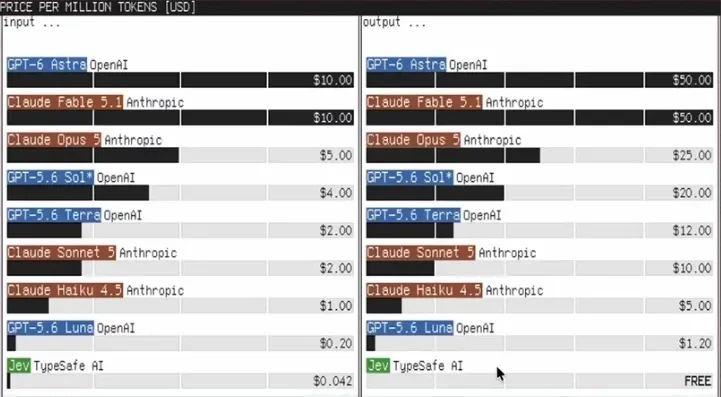
One caution though, these speed and price figures come from the company itself, so it is wise to test them on your own task.
How Jev learned
Chat models like ChatGPT learned partly through RLHF, short for reinforcement learning from human feedback. Imagine a teacher holding up two answers, A and B, and asking which one you prefer. The model learns to produce answers people like. But it is slow and costly, and it rewards pleasing people more than being honest about how sure the model is.
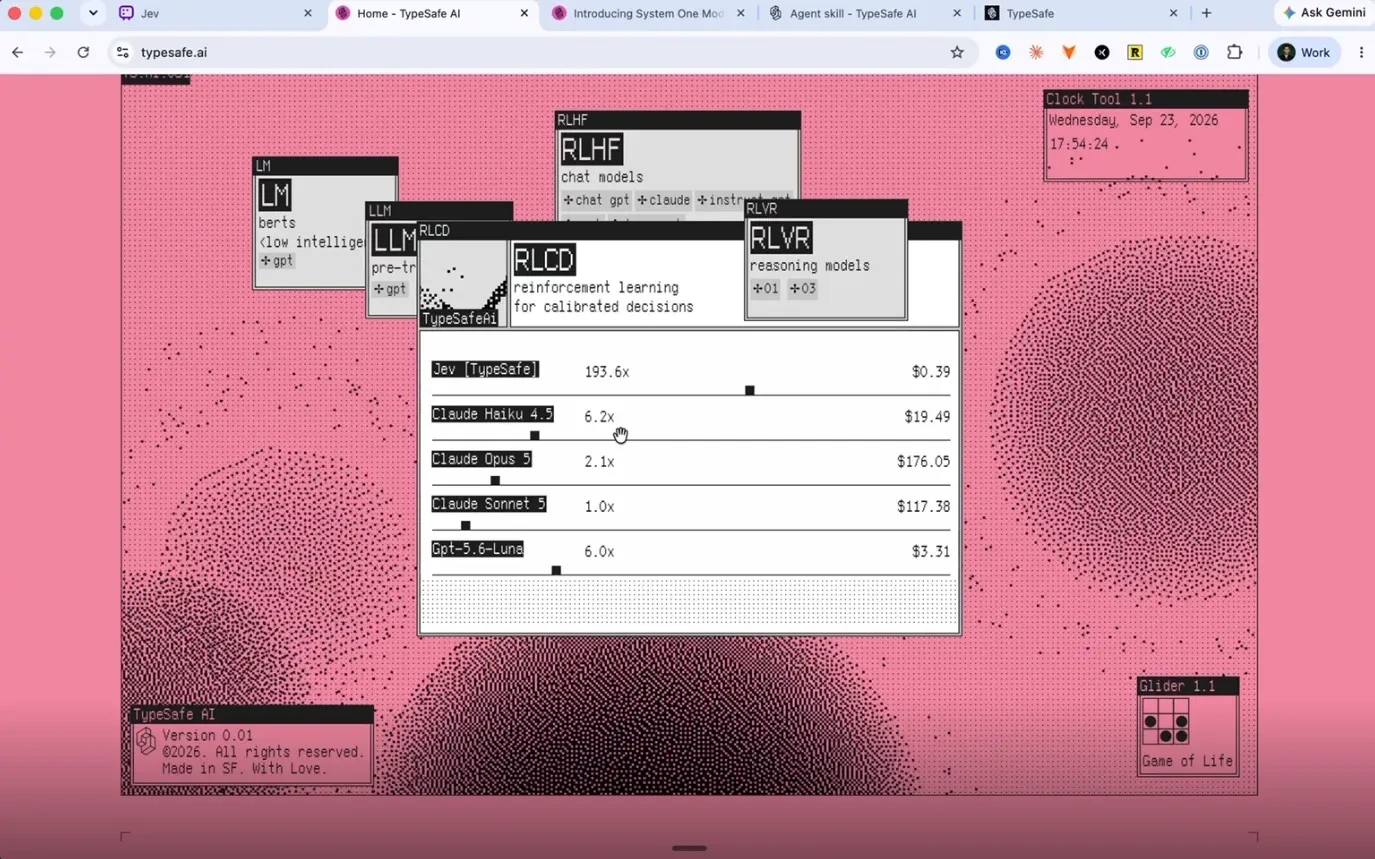
Diogo Almeida helped build RLHF too. For Jev, his team made a new method called RLCD, reinforcement learning for calibrated decisions. Think of a weather forecaster who says “90% chance of rain.” An honest forecaster is right about nine times in ten. That is what “calibrated”(confidence matches reality).
What Jev can read
Jev can read only text. Jev cannot look at pictures. To decide something about a photo, you first run a picture-reading tool (OCR, or an image model) to turn it into words. Then Jev decides.
Jev cannot talk, so how does it reply? In one of three formats. Here is a story that shows all three.
A customer writes to a shop: “I was charged twice!”
Choice. Pick one option from a list. The shop has teams for billing, technical problems and sales. Jev picks the right team and gives a probability and a confidence score: “Billing, almost certainly. Maybe a small chance it is technical, since a bug could cause double charges.” A program that sends each request to the right place like this is called an orchestrator, like a traffic officer pointing cars down the correct road.
Noul. A yes-or-no answer type. Question: “Was the customer charged twice?” Jev answers 0.98, a number from 0 to 1 that means “yes, I am almost completely sure.”
Score. A position on a scale. How upset is the customer: calm, annoyed or angry? Jev might answer 0.3, that might mean “a little annoyed”, which makes sense, since it is their money.
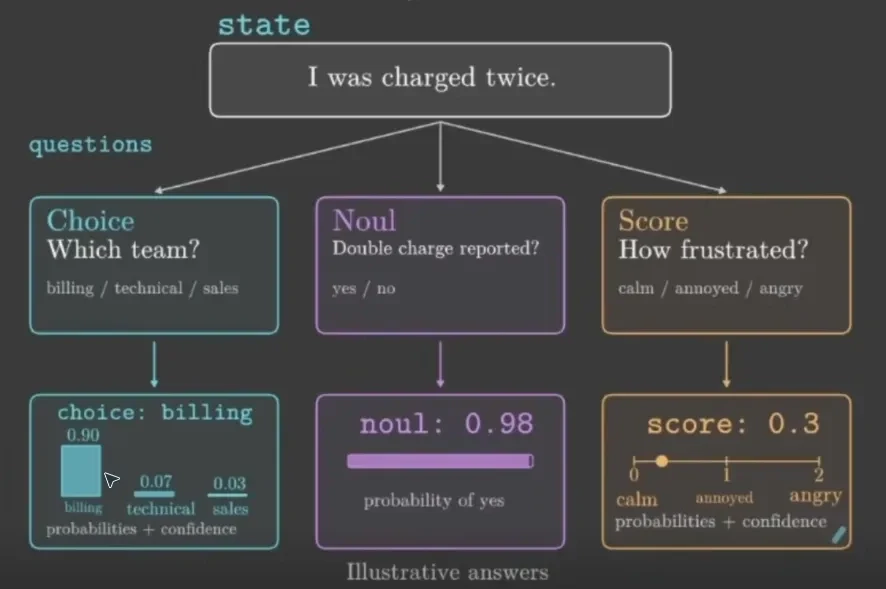
The shop’s own software then uses these answers to decide what to do next. In that sense Jev acts like a smarter “if... then...” rule inside a program. It is fast enough for real-time uses, where waiting several seconds would spoil the experience.
One last thing…
Jev guarantees the shape of an answer, not its correctness. A Choice can only return one of the supplied options, yet a wrong option can still arrive with high confidence. Its docs suggest treating confidence like a triage nurse- high confidence acts automatically, middle confidence asks a person, and low confidence hands the case over.
Jev also cannot write or chat, so the safest test is a batch of cases with known answers, run beside the current method first.
A model does not need to talk to be useful. Jev bets that many everyday decisions, such as routing a ticket or labeling 1,000 companies, need a fast answer and an honest confidence number, not an essay. Replies in roughly 100 milliseconds at $0.042 per million input tokens make that bet cheap to test. My sign-off sums up the approach: eat, sleep, build and repeat.
Which decision in your own work is small, repetitive and currently left to a brittle rule or an expensive chat model?
If you want to explore more about the model refer to this video: Link
Q1. What is Jev AI?
Jev is an AI model designed to make fast, structured decisions instead of generating conversational text.
Q2. What makes Jev different from LLMs?
Unlike traditional language models that generate text token by token, Jev focuses on producing decisions in a single step.
Q3. What can Jev be used for?
Jev can handle tasks such as classification, ticket routing, scoring, labeling, and other repetitive decision-making workflows.
Q4. What are Jev’s output formats?
Jev provides structured outputs such as Choice for selecting options, Noul for yes-or-no decisions, and Score for numerical assessments.
Q5. Can Jev’s confidence score guarantee a correct answer?
No. Confidence indicates how certain the model is, but it does not guarantee correctness. High-impact or uncertain decisions should still involve human review.