Key Takeaways
Your website is a core growth engine, not a brochure performance, UX, SEO, and scalability directly impact trust, conversions, and revenue.
The best agencies go beyond design, integrating strategy, UX, SEO, performance, analytics, and CRO to build sites that improve over time.
Choosing the wrong agency leads to hidden technical debt and rebuilds; the right partner compounds value through ownership, support, and iteration.
Currently, your website is not just a digital brochure. It is your most important growth channel.
For most businesses, it is the first touchpoint, the strongest brand signal, and the place where revenue decisions actually happen. Whether someone is evaluating your product, comparing alternatives, or deciding to contact your team, your website does the heavy lifting long before a sales call.
That is why choosing the right website development agency matters more than ever.
A poorly built website slows down performance, hurts SEO, weakens trust, and quietly kills conversions. These issues are not always obvious on day one, but they compound over time. Slow load speeds, unclear user journeys, rigid tech stacks, and weak post-launch support often force expensive rebuilds just months later.
The best website agencies think far beyond design. They combine strategy, UX, performance engineering, SEO foundations, and scalable technology to build websites that grow with your business, not against it.
This guide is designed to help founders, marketing teams, and business leaders understand how to evaluate and choose a website development agency that delivers real outcomes. Not just a good-looking site, but one that performs, converts, and scales.
You will learn what separates a true website partner from a basic vendor, which criteria actually matter when evaluating agencies, and how to avoid the most common hiring mistakes.
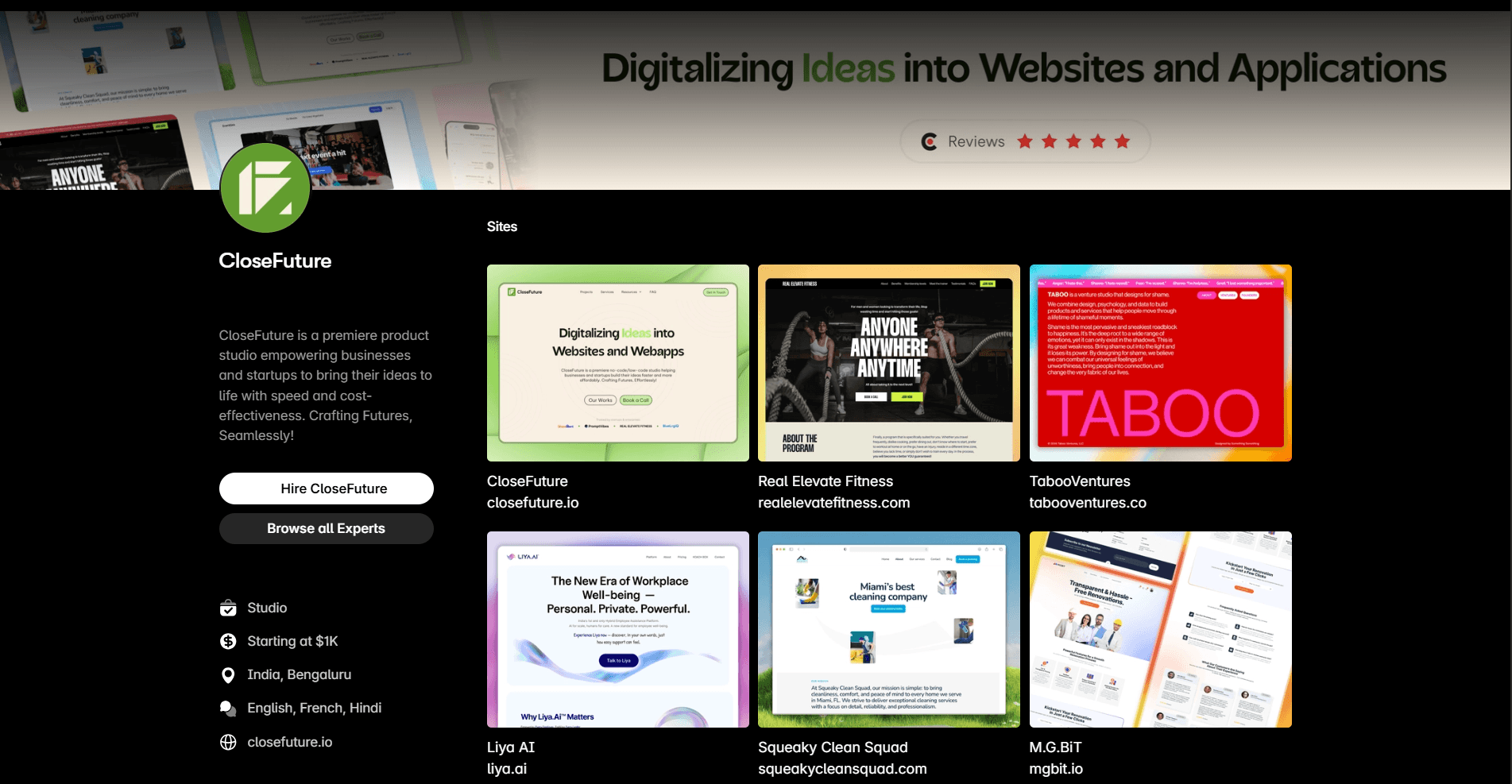
Throughout this guide, we will also show how CloseFuture approaches website development with a performance-first mindset, blending strategy, design excellence, and modern technology to build websites that drive measurable growth.
What Does a Website Development Agency Actually Do?
A high-quality website development agency is not just responsible for how your site looks. It owns how your website performs, converts, ranks, and scales over time.
Here is what that actually includes.
Strategy, UX, Design, and Development
Everything starts with strategy. A strong agency aligns your website with business goals, audience intent, and growth metrics before a single screen is designed.
From there, UX and information architecture shape how users move through the site. Clear navigation, intentional page flows, and frictionless journeys matter more than visual trends.
Design and development then bring this strategy to life. The best agencies build scalable design systems, maintain clean codebases, and choose technologies that support speed, flexibility, and long-term ownership. The goal is not a one-time launch, but a foundation that can evolve with your business.
SEO Foundations and Performance Optimization
SEO is not an add-on. It is built into the structure of the website itself.
This includes semantic HTML, proper heading hierarchy, internal linking, schema readiness, mobile-first layouts, and fast load times. Performance optimization, including Core Web Vitals, directly impacts search rankings, user experience, and conversion rates.
Agencies that treat SEO and performance as post-launch tasks often limit a website’s growth before it even goes live.
Analytics, CRO, and Post-Launch Improvements
A website launch is not the finish line. It is the starting point.
A performance-focused agency sets up analytics, event tracking, and conversion measurement from day one. This data reveals how users actually behave, where they drop off, and which pages underperform.
CRO and iteration turn insights into action. Through testing, refinement, and continuous improvement, the website becomes more effective over time, not stagnant.
Ongoing Technical Support and Scaling
As your business grows, your website must grow with it.
This includes technical maintenance, security updates, performance monitoring, documentation, and clear ownership of code and assets. A reliable agency ensures your site can handle increased traffic, new integrations, and future feature expansion without forcing costly rebuilds.
This long-term support is what separates a short-term vendor from a true website partner.
Key Factors to Consider When Choosing a Website Development Agency
Not all website agencies are built for growth. Many can deliver something that looks good. Far fewer can build something that performs, scales, and compounds value over time.
These are the factors that actually matter when evaluating a website development agency in 2026.
1. Proven Experience & Portfolio Quality
A polished portfolio does not automatically mean strong results.
What you should look for is evidence of real business outcomes, not just attractive visuals. Strong agencies showcase case studies that explain the problem, the approach, and the measurable impact on conversions, performance, or growth.
Industry relevance also matters. An agency that has built SaaS platforms, marketplaces, or high-conversion marketing sites will understand your challenges faster than one that works only on brochure websites.
Testimonials, long-term client relationships, and repeat engagements are strong indicators of reliability and delivery quality.
2. UX & Conversion-Focused Design
Great websites are designed to guide users, not impress other designers.
A conversion-focused agency prioritizes clarity, usability, and intent-driven design. This includes logical navigation, strong visual hierarchy, frictionless forms, and CTAs placed where users are ready to act.
Design decisions should always be tied to outcomes. Better engagement, higher conversion rates, and clearer user journeys. If an agency talks only about colors and layouts without mentioning funnels or behavior, that is a red flag.
3. SEO-Ready Architecture
SEO starts at the structural level of a website.
A strong agency builds websites with clean HTML, proper heading hierarchy, internal linking, schema readiness, and crawlable site architecture. Content structure, page depth, and URL strategy all influence how well a site ranks and scales in search.
Site performance and SEO are deeply connected. Without technical SEO and speed optimization baked in from the beginning, even great content struggles to perform.
4. Performance & Core Web Vitals
Performance is no longer optional. It directly affects rankings, user trust, and conversion rates.
A serious website agency prioritizes fast load times, mobile-first builds, optimized assets, and strong Core Web Vitals scores. This requires intentional design choices, efficient code, and modern frameworks.
At CloseFuture, performance is treated as a design constraint, not a post-launch fix. Every layout, animation, and integration is evaluated based on how it impacts speed and usability.
5. Scalability & Tech Stack Choices
The wrong tech stack can lock your business into costly rebuilds.
A future-ready agency helps you choose platforms and architectures that scale with your needs. This may include headless setups, modern CMS options, flexible integrations, and API-first approaches.
Scalability is not just about traffic. It is about content growth, feature expansion, marketing experimentation, and team collaboration without technical bottlenecks.
6. Support, Maintenance & Ownership
Many agencies disappear after launch. That is a risk you cannot afford.
You should have clear answers to who owns the code, where the site is hosted, and how updates and maintenance are handled. Documentation, handover processes, and long-term support plans matter as much as the initial build.
A reliable agency remains accountable after launch, ensuring security, performance, and scalability as your website evolves.
Red Flags When Hiring a Website Development Agency
Some agency problems are obvious. Others only surface months after launch, when performance stalls and fixes become expensive.
Watch out for these red flags before signing a contract.
Design-Only Focus Without SEO or UX
If an agency’s pitch revolves entirely around visuals, trends, and aesthetics, proceed carefully.
Websites built without a UX strategy or SEO foundations often look impressive but fail to convert or rank. Design should support user journeys, search visibility, and business goals, not exist in isolation.
A strong agency can clearly explain how design decisions impact usability, performance, and conversions.
No Analytics or CRO Expertise
If an agency does not talk about analytics, it is not building for outcomes.
Without proper tracking, event setup, and conversion measurement, you have no way to understand how users interact with your site or where growth opportunities exist.
Agencies that lack CRO expertise typically treat websites as static projects rather than evolving growth platforms.
No Documentation or Handover
A website should never be a black box.
If there is no documentation, no structured handover, and no clarity on how the site is built, you risk long-term dependency on the agency. This makes future updates slower, more expensive, and harder to manage internally.
Professional agencies prioritize transparency, documentation, and ownership from day one.
Over-Dependency on Plugins or Page Builders
Excessive reliance on plugins and page builders often creates hidden technical debt.
While tools can speed up development, overuse leads to bloated code, security vulnerabilities, slower performance, and limited scalability. It also restricts flexibility when you need custom functionality later.
A future-ready agency uses tools intentionally and builds systems that can scale without breaking under complexity.
Website Agency vs Freelancers
Both website agencies and freelancers have their place. The right choice depends on your goals, timelines, and expectations around performance and scale.
For businesses that see their website as a long-term growth asset, the differences matter.
Factor | Website Agency | Freelancers |
Strategy | Deep, structured, and business-aligned | Often limited or informal |
UX & CRO | Built into the process | Varies by individual |
SEO | Integrated from day one | Not guaranteed |
Scalability | Designed to grow with the business | Limited by capacity |
Support | Ongoing and predictable | Case-by-case |
Freelancers can be effective for small projects, quick fixes, or tightly scoped tasks. However, they usually operate in isolation. Strategy, UX, SEO, performance, and analytics are often handled separately, if at all. This can lead to fragmented decision-making and inconsistent outcomes.
A website agency brings cross-functional expertise under one roof. Strategy informs design. Design supports UX and conversions. Development prioritizes performance and scalability. SEO and analytics guide continuous improvement. The result is a website built as a system, not a collection of pages.
How CloseFuture Blends Creativity, Performance, and Growth
At CloseFuture, we combine the creative flexibility people love about freelancers with the structure, accountability, and depth of a high-performance agency.
Creativity shapes strong brand expression and intuitive design. Performance engineering ensures speed, stability, and Core Web Vitals excellence. Growth strategy ties everything together through SEO, CRO, analytics, and iteration.
This integrated approach allows us to move fast without cutting corners and to build websites that not only look great, but convert, rank, and scale as your business grows.
Questions to Ask Before Hiring a Website Development Agency
Before you commit to a website development agency, the right questions can reveal how they think, how they work, and whether they are built for long-term success or short-term delivery.
These questions help separate confident partners from surface-level vendors.
1. How do you ensure performance and SEO?
A strong agency should be able to explain performance and SEO clearly, without vague promises.
Listen for answers that mention technical SEO, Core Web Vitals, mobile-first builds, semantic structure, clean code, and performance testing. If performance or SEO is treated as a post-launch phase, that is a warning sign.
2. Will I own the website fully?
Ownership matters more than most teams realize.
You should have full ownership of the code, content, design assets, and hosting setup. The agency should be transparent about access, documentation, and handover processes.
Avoid arrangements that lock you into proprietary systems or make it difficult to switch providers later.
3. What reporting and analytics do you set up?
If an agency cannot explain how success is measured, success is likely not being tracked.
Ask about analytics tools, event tracking, conversion measurement, and dashboards. A performance-focused agency uses data to guide decisions, not opinions or assumptions.
4. How do you manage CRO and Iteration?
Websites should improve over time, not stay static.
Ask how the agency identifies opportunities for optimization, runs experiments, and iterates based on user behavior. CRO should be a structured process, not an occasional suggestion.
This reveals whether the agency is invested in long-term outcomes or just launching delivery.
5. What happens after launch?
The post-launch phase often defines the true value of an agency.
Clarify what support looks like after go-live. This includes maintenance, security updates, performance monitoring, bug fixes, and ongoing optimization. Clear processes here indicate accountability and partnership, not abandonment.
How CloseFuture Builds High-Performing Websites
At CloseFuture, we do not treat websites as one-time projects. We treat them as long-term growth systems.
Strategy-First Approach
Every project begins with clarity. We align the website with business goals, audience intent, and measurable outcomes before design or development starts. This ensures every decision supports growth, not guesswork.
Design Systems and Scalable Builds
We build design systems, not isolated pages. This allows brands to scale content, launch new pages, and evolve without breaking consistency or performance.
Our development approach prioritizes clean architecture, modern frameworks, and flexibility so your website remains fast, stable, and easy to extend.
SEO, CRO, and Analytics From Day One
Search visibility, conversion tracking, and performance measurement are built into every CloseFuture website from the start.
We implement technical SEO, event tracking, and conversion measurement early, so decisions are guided by real user data, not assumptions.
Continuous Optimization Programs
Launch is only the beginning.
We help teams refine, test, and optimize their websites over time through ongoing performance monitoring, UX improvements, and CRO initiatives. This ensures your website improves as your business grows.
Build a website designed for growth with CloseFuture.
The Right Agency Multiplies Your Growth
Your website is one of your most valuable long-term business assets.
Choosing a website development agency based only on price often leads to slow performance, missed opportunities, and costly rebuilds. The right agency compounds value by building a website that supports growth, adapts to change, and delivers measurable results.
CloseFuture builds websites that convert, scale, and grow revenue through strategy-led design, performance-first development, and continuous optimization.
Looking for the right website agency? Talk to CloseFuture.
Q1. What should I look for in a website development agency?
Look for an agency that combines strategy, UX, SEO, and performance, not just design. Strong case studies, clear processes, and long-term support matter more than visuals alone. The agency should understand growth goals, not just pages.
Q2. How much does it cost to hire a website development agency in 2026?
Costs typically range from $5,000 to $15,000 for marketing websites and $15,000 to $40,000+ for performance-driven or SaaS websites. Pricing depends on strategy depth, UX complexity, performance requirements, and ongoing optimization.
Q3. How long does it take to build a high-quality website?
Most high-quality websites take 3 to 6 weeks from discovery to launch. Timelines vary based on scope, integrations, content readiness, and performance or SEO requirements.
Q4. Should I hire freelancers or a website development agency?
Freelancers are suitable for small, well-defined tasks. Agencies are better for businesses that need structured strategy, SEO, UX, performance, and scalable systems working together.
Q5. How do I know if an agency is good at SEO and performance?
A strong agency can explain its technical SEO approach, show Core Web Vitals results, and demonstrate ranking or performance improvements from past projects. If SEO or performance is treated as an afterthought, that is a red flag.