Key Takeaways
Bubble enables fast MVP launches, but poor early architecture and hiring choices often cause scaling, performance, and maintenance issues later.
Freelancers are ideal for quick, well-scoped builds, while agencies offer structure, scalability, and long-term reliability for growing products.
CloseFuture combines freelancer speed with agency-grade architecture, support, and scalability to build Bubble apps that last.
Bubble has made it possible to build powerful products faster than ever. Startups can launch MVPs in weeks, validate ideas quickly, and ship features without traditional engineering overhead. However, speed alone does not guarantee success.
The real risk appears after launch. Poor architecture, unoptimized workflows, and missing documentation often become apparent when users grow, integrations expand, or performance becomes a priority. Many teams realise too late that their early hiring decisions are now slowing them down.
This is where the choice between a Bubble freelancer and a Bubble development agency becomes critical. Freelancers can move fast, but agencies bring structure, accountability, and scalability. CloseFuture sits at the intersection of both. We deliver the speed founders expect, with the production-ready thinking required to build Bubble products that last.
What Is a Bubble Freelancer?
A Bubble freelancer is an independent no-code developer who builds and maintains Bubble apps on their own, without the backing of a larger team.
Most Bubble freelancers are a good fit for small, well-scoped projects. This includes early MVPs, internal tools, or quick feature experiments where speed matters more than long-term architecture. They usually work fast, adapt quickly, and require lower upfront investment compared to agencies.
However, freelancers also come with built-in limitations. Since all responsibility sits with one person, availability, consistency, and long-term maintenance can become challenges. As the app grows in users, workflows, or integrations, scalability and performance optimization often start to suffer without a structured development process in place.
What Is a Bubble Development Agency?
A Bubble development agency is a team of specialists who design, build, and maintain Bubble applications collaboratively, rather than relying on a single developer.
These agencies bring structure, accountability, and expertise across multiple areas, including design, development, quality assurance, and integrations, making them ideal for complex, customer-facing apps or products expected to scale. They can handle sophisticated workflows, implement best practices for performance, and ensure long-term maintainability.
CloseFuture follows a lean, senior-team approach. Our experts deliver fast, production-ready Bubble builds while maintaining clean architecture, thorough testing, and scalable solutions.
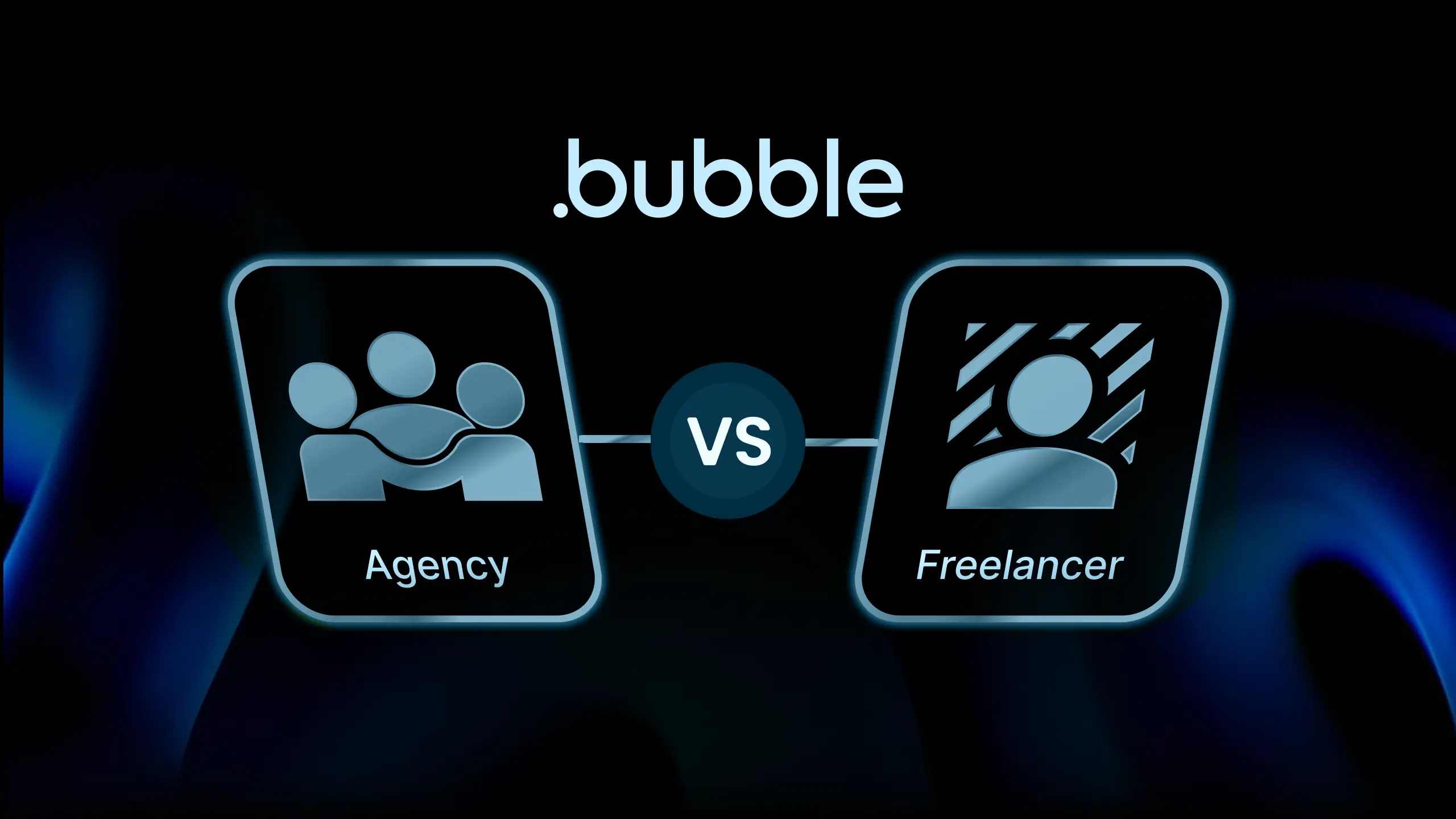
Bubble Agency vs Freelancers: Side-by-Side Comparison
Choosing between a Bubble agency and a freelancer isn’t just about speed or cost. Understanding the trade-offs in scalability, reliability, and support can save your product from future headaches.
Factor | Bubble Agency | Bubble Freelancer |
Speed | Fast & structured | Fast initially |
Cost | Predictable | Variable |
Scalability | High | Limited |
Architecture | Production-grade | MVP-level |
Reliability | Team-backed | Single dependency |
Support | Ongoing | Limited |
Why it matters:
Freelancers are great for rapid prototypes or small tasks, but long-term projects need structure, scalability, and reliability. Bubble agencies, like CloseFuture, combine the speed and flexibility of freelancers with robust architecture, consistent delivery, and ongoing support, so your app can grow without costly rewrites or downtime.
When Hiring a Bubble Freelancer Makes Sense
Freelancers shine when speed and flexibility matter more than long-term structure. They are ideal for short-term projects where requirements are clear and risks are low.
Early-stage MVPs or experiments: Freelancers can help you validate ideas quickly without committing to a full-scale architecture.
One-off features or internal tools: Small tasks, automation scripts, or internal dashboards can be built efficiently by a solo developer.
Clearly defined, short-term scope: Freelancers perform best when the project requirements are fixed, and the work does not require frequent iteration or cross-team collaboration.
Key takeaway: Freelancers are great for rapid validation and simple builds, but as your product grows, their single-point-of-failure model and limited scalability can become a bottleneck.
When You Should Hire a Bubble Agency
Hiring a Bubble agency makes sense when your product is expected to grow, serve real users, or handle complex workflows. Agencies bring structure, expertise, and long-term reliability that freelancers often cannot provide.
Customer-facing or revenue-generating products: Production-grade apps need stable architecture, monitoring, and reliable performance to support real users.
Apps expected to scale in users or complexity: Agencies design for growth, ensuring your app can handle more users, features, and data without breaking.
Need for integrations, performance tuning, and security: From payments and APIs to authentication and data privacy, agencies follow best practices that reduce risks.
Requirement for documentation, testing, and post-launch support: Clear handovers, testing workflows, and ongoing support ensure maintainability and smooth future iterations.
Complex business logic and workflows: Apps with conditional logic, multi-step processes, or automation benefit from an agency’s structured approach.
Compliance and industry requirements: Agencies ensure apps meet legal or regulatory standards (like GDPR, HIPAA) if relevant.
Team collaboration and coordination: Agencies can work seamlessly with your in-house or external teams (marketing, design, operations).
Future-proofing the product: Agencies design apps so that adding features later is smooth, avoiding technical debt or messy rewrites.
Performance monitoring and analytics: Setting up dashboards, metrics, and logs for real-time monitoring is often skipped by freelancers.
Key takeaway: Agencies are the right choice when you need long-term stability, scalability, and a professional foundation for your Bubble app.
Common Risks of Hiring Freelancers for Bubble Apps
Freelancers can move fast, but relying on a solo developer for Bubble projects comes with hidden risks:
Inconsistent availability: Freelancers juggle multiple clients, which can delay critical updates or fixes.
Limited performance optimization: Without deep expertise, apps may run slower or encounter scaling issues as users grow.
Difficult long-term maintenance: Solo developers may not anticipate future growth, resulting in technical debt or frequent rewrites.
Security vulnerabilities: Freelancers may overlook proper authentication, API key management, or sensitive data handling.
Limited testing & QA: Solo work often skips structured testing, leading to bugs and unstable releases.
Difficulty integrating complex workflows: Apps requiring APIs, payments, or advanced workflows may face patchwork solutions.
Unpredictable cost in the long run: Quick fixes or inefficient workflows can create hidden costs as the product scales.
Single point of knowledge: If the freelancer becomes unavailable, your project may stall or require a costly ramp-up for replacements.
Why this matters: These risks show that while freelancers can deliver quick MVPs, scaling, stability, and reliability are best handled by structured teams, making a Bubble agency the safer, long-term choice.
How CloseFuture mitigates these risks:
By combining structured processes, architecture planning, and code reviews, CloseFuture ensures Bubble apps are fast, reliable, and built to scale. Teams get clear documentation, maintainable workflows, and ongoing support, eliminating the common pitfalls of freelance development.
Cost Comparison: Bubble Agency vs Freelancer
At first glance, hiring a freelancer may seem cheaper, but the long-term costs can add up.
Freelancers: Lower upfront fees, but potential hidden costs from rework, inconsistent quality, and technical debt.
Agencies: Higher initial investment, yet reduced long-term costs thanks to production-ready architecture, structured processes, and scalable solutions.
CloseFuture: Offers startup-friendly pricing that balances speed, quality, and predictability, helping teams avoid surprises while building for growth.
How CloseFuture Bridges the Gap
Choosing between speed and reliability doesn’t have to be a trade-off. CloseFuture delivers both for Bubble projects, giving founders confidence in launch and scale.
Fast delivery without compromising scalability: Get your product to market quickly while ensuring it’s built for growth.
Senior Bubble developers only: Experienced engineers handle architecture, workflows, and integrations with precision.
Robust architecture & workflow design: Build apps that can handle more users, complex logic, and high-demand features from day one.
Performance optimization & monitoring: Ensure fast load times, smooth user experience, and minimal downtime.
Seamless integrations: Payments, APIs, authentication, and third-party tools done correctly and securely.
Clean documentation and long-term support: Your team can maintain, scale, or hand over the app confidently.
Cost-efficient builds: Minimize rework and technical debt to save time and money in the long run.
Future-ready approach: Apps are designed to evolve with your business, avoiding common pitfalls of short-term thinking.
“Get the speed of freelancers with the reliability of an agency—build with CloseFuture.”
Conclusion
When deciding between a Bubble freelancer and an agency, consider the trajectory of your product. Freelancers are ideal for short-term, low-risk projects or early MVP experiments, offering speed and flexibility. Agencies, on the other hand, are best for customer-facing, revenue-generating products that require scalability, robust architecture, and ongoing support. CloseFuture bridges the gap by combining fast delivery with production-grade reliability, ensuring your Bubble app is built to grow and last.
“Not sure which option fits your project? Talk to CloseFuture.”
Q1. Is it cheaper to hire a Bubble freelancer than an agency?
Freelancers may cost less upfront, but agencies reduce hidden costs from rework, tech debt, and scalability issues.
Q2. Can Bubble freelancers build production-ready applications?
They can handle simple MVPs, but complex, scalable, and high-traffic apps often exceed their capacity.
Q3. When should startups choose a Bubble agency over freelancers?
When building customer-facing products, apps with complex workflows, or projects intended to scale long-term.
Q4. What are the biggest risks of hiring Bubble freelancers?
Inconsistent availability, limited performance optimization, poor documentation, and long-term maintenance challenges.
Q5. How do Bubble agencies handle scalability and performance?
Agencies implement production-grade architecture, optimize workflows, and ensure apps can grow without breaking.
Q6. Can I switch from a Bubble freelancer to an agency mid-project?
Yes, but handovers can be tricky; structured documentation and architecture planning make the transition smoother.
Q7. What level of documentation should I expect from a Bubble agency?
Comprehensive documentation covering architecture, workflows, integrations, and post-launch guidance for maintainability.
Q8. Why choose CloseFuture instead of a Bubble freelancer?
CloseFuture combines freelancer-level speed with agency-grade reliability, scalable architecture, optimized performance, and ongoing support.